

As required by the IBDP, students choose their courses from each of these six subject areas:
Typically, students study three subjects at standard level and three at a higher level.
The difference in the courses relates to the time allocated to teaching – 240 hours for HL and 150 hours for SL – and the amount of content covered. SL courses are not easier options than HL courses; they are “just” shorter.


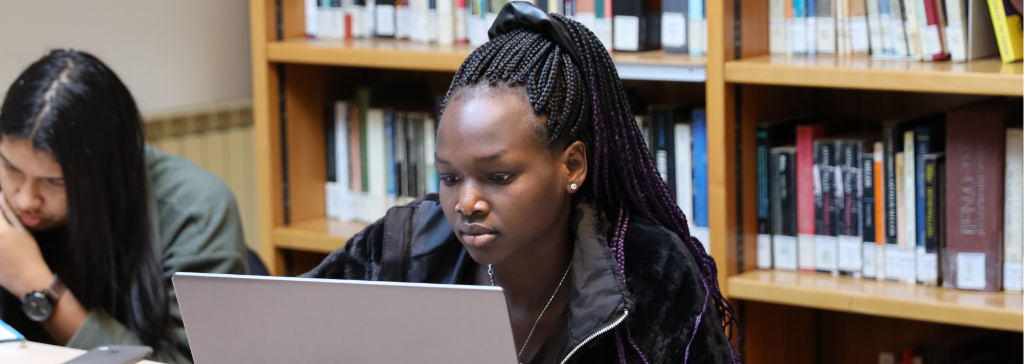
Offered courses:
Language A – Literature
Language A – Language and Literature
School Supported Self-Taught languages
These courses are taught in the following languages:
Arabic – Bosnian – Croatian – English – French – German – Italian – Serbian – Slovenian – Spanish – Russian
What you can expect to learn:
All students in these courses study literary works in various forms, written at different periods of time and from different cultures, including works in translation. During the course they may study selected novels, poetry, drama and non-fiction from India, Nigeria, South Africa, the UK and North America, and works in translation from Italy, Japan, Mexico and Ancient Greece.
Language and Literature students study fewer literary works but are also exposed to non-literary works such as film, advertisements, opinion columns and visual literacy. Through interactive class discussions and activities focussed on written and verbal skills, students work on close reading and textual analysis, language skills both written and oral, communication skills to develop a deep appreciation and understanding of how language shapes meaning. Students reflect on and explore how texts portray global issues and making connections across literary genre and non-literary form, time periods and cultural context.
This course allows students to study literature in their native or primary language, giving them the chance to gain deeper understanding of texts that reflect their own cultural and linguistic background.
We strongly encourage students to study the literature of their own languages and cultures as part of our commitment to deliberate diversity and intercultural understanding and respect.
Offered courses:
English B – Italian B – Italian Ab Initio
What you can expect to learn:
In this course students further develop their skills in language reception and production by studying global issues and current affairs through a wide range of personal, professional, and mass media texts, such as blog entries, speeches, news reports and film. Through interactive class activities, students look closely at the form and impact of written and spoken language in different forms, developing close reading skills and learning how to write for different purposes. Students also study a minimum of two literary texts, and the issues and ideas explored by the writers of those texts.
What you can expect to learn:
These courses use a communicative approach to aid language acquisition. They foster the development of reading, listening, speaking, and writing skills through the study of a wide range of texts.
The Italian B Standard Level course caters for learners who have had some previous exposure to Italian or similar languages and/or have an interest in languages. The pace of the course is slightly faster than the course at Ab Initio.
Italian Ab Initio is a foreign language course designed for complete beginners who are not familiar with any Roman language.
What you can expect to learn:
Economics course allows students to develop an understanding of the complexities and interdependence of economic activities in a rapidly changing world.
As a social science, the economics course – at both SL and HL – use microeconomics, macroeconomics, and global economy studies to examine the ways in which choices focused on the problem of scarcity are made.
In addition, Economics students learn research skills by completing an Internal Assessment coursework.
What you can expect to learn:
As a transdisciplinary subject this course is designed to combine the techniques and knowledge associated with Group 4 – Science, with Group 3 – Individuals and Societies.
The focus of the course is to explore the systems that make up life on our planet, that means investigating the science behind some of the things we take most for granted, discussing a wide range of environmental issues, and different cultural and personal values.
Students undertake practical work in the outdoor environment: learning to monitor biodiversity, test water and air quality, and measure the consequences of different human activities. Furthermore, students are encouraged to bring their own experiences and knowledge of their local systems to our classroom, and to share it with others.
The course covers the following core topics:
What you can expect to learn:
In Global Politics students examine the way human beings treat each other through political institutions, focusing on the basic question: how should life be lived?
The course embodies values, interests, and ideals about life’s goals, also exploring the way values, interests, and ideals influence relationships among groups, nations, and humanity.
The topics covered at SL and HL level has four interconnected units:
These units are built on the unifying themes of “People, Power, and Politics”, addressing questions about the relations between states and individuals, economic growth and ecological principles, violence and coexistence, and the dynamics of power in a world of immigrants, refugees, or stateless.
What you can expect to learn:
History is a dynamic, contested, evidence-based discipline that involves an understanding of the past, which leads to a deeper understanding of the world of today and the nature of humans, developing the skills of critical thinking in different perspectives.
The course is focused on key historical concepts of change, continuity, causation, consequence, significance, and perspectives.
In addition, History students learn research skills by completing an Internal Assessment coursework and enjoy field trips to historical sites, museums in Italy and further afield.
The topics covered at SL and HL level include:
What you can expect to learn:
Philosophy is a systematic critical inquiry into stimulating and challenging questions that arise out of everyday experiences.
The course encourages students to appreciate and join philosophic conversation with some humility and respect. It also develops highly transferable skills such as the ability to formulate arguments clearly, make reasoned judgements and evaluate highly complex and multifaceted issues.
In addition, Philosophy students learn research skills by completing an Internal Assessment coursework.
The overarching emphasis on both SL and HL level is on “doing philosophy”, that is, on actively engaging students in philosophical activity. The topics covered include:
Offered courses:
Biology – Chemistry – Environmental Systems & Societies – Physics
Sciences share a common syllabus structure: the subject core is divided into topics required at both HL and SL, and those for HL only. The SL courses reach a level of sophistication comparable with HL, but in limited areas only.
Almost half of the course is devoted to practical work, part of which is an interdisciplinary project in which students from two or more science courses work together on different aspects of the same problem.
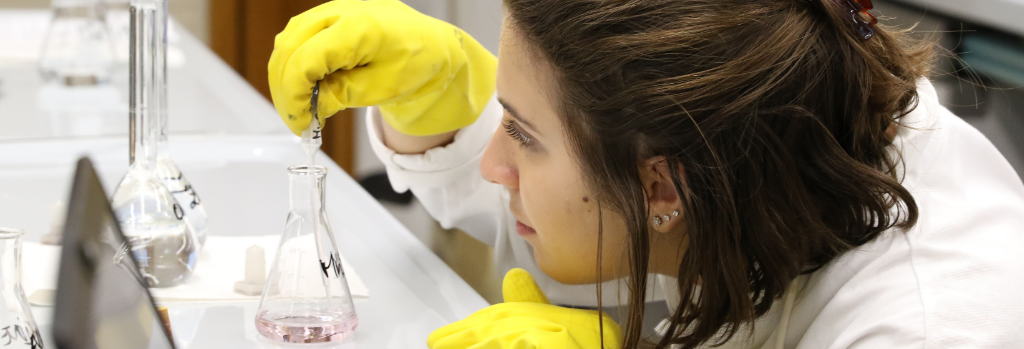
The IB Biology course is structured according to these themes:
The themes of this course are taught through topics of cell biology and molecular biology, cell respiration, photosynthesis, genetics, ecology, evolution and biodiversity, animal physiology. Biochemistry is the major component of this course – both HL and SL – and it is
embedded in multiple chapters.
The structure of the chemistry course is intended to promote concept-based teaching and learning.
There are two organising concepts in the chemistry roadmap: structure and reactivity. Each of these concepts is subdivided into topics and subtopics.
The chemistry course involves an inquiry-based teaching approach, which fosters a high degree of student engagement, collaboration and interaction. The inquiry, design, experimental, analysis, evaluation and communication skills serve students well as they prepare to undertake a scientific investigation.
As a transdisciplinary subject this course is designed to combine the techniques and knowledge associated with Group 4 – Science, with Group 3 – Individuals and Societies.
The focus of the course is to explore the systems that make up life on our planet, that means investigating the science behind some of the things we take most for granted, discussing a wide range of environmental issues, and different cultural and personal values.
Students undertake practical work in the outdoor environment: learning to monitor biodiversity, test water and air quality, and measure the consequences of different human activities. Furthermore, students are encouraged to bring their own experiences and knowledge of their local systems to our classroom, and to share it with others.
The course covers the following core topics:
The IB Physics course is structured according to five themes:
The treatment of the subject is less mathematically rigorous than in some national systems, the emphasis being rather on the acquisition of the physical concepts and their relationship to each other. Basic algebra and trigonometry are used routinely, but calculus is not required although it may be used in class in the second year.
Offered courses:
AI or Mathematics: Applications and Interpretation Standard Level
AA or Mathematics: Analysis and Approaches Standard Level
AA or Mathematics: Analysis and Approaches Higher Level
The subject core is divided into topics required at both HL and SL.

This path focuses on using maths in real-world situations. It is for students who like using maths to solve real problems, approaching things like statistics, money maths, modelling, and other useful maths for careers in social sciences, biology, or business.
This course is appreciated by students interested in areas like humanities or arts.
The IB DP Mathematics: applications and interpretation course recognise the increasing role that mathematics and technology play in a diverse range of fields in a data-rich world. As such, it emphasises the meaning of mathematics in context by focusing on topics that are often used as applications or in mathematical modelling.
This course is focused developing important mathematical concepts in a comprehensible, coherent and rigorous way, achieved by a carefully balanced approach. Students are encouraged to apply their mathematical knowledge to solve abstract problems as well as those set in a variety of meaningful contexts.
This path covers a lot of maths topics to give a good base, going deeper into advanced maths like proofs, complex numbers, vectors, and tough equations.
During maths classes, teachers use TI-NSpire CX calculators to demonstrate how to solve problems.
Students may purchase their own calculators before coming to UWC Adriatic or choose to “borrow” one from the college.
Offered courses:
Music – Theatre Arts – Visual Art – Theory of Knowledge (TOK) – Extended Essay
Alternatively at the art courses, students can opt for another science, individuals and societies, or a language acquisition subject.
The Music programme is essentially practical and creative. Music students of all abilities are encouraged to develop their own individual skills and interests in music as well as expand their expertise and musical knowledge both in and outside the classroom. There is an increasing focus on developing skills in using Music Technology. The curriculum focuses on performance, composition and listening skills as well as academic skills such as analysis and appreciation of music from a variety of cultural backgrounds. The proximity to cities with an abundance of musical performances allows for visits to concerts and/or opera performances.
Throughout the course students take on the roles of researcher, creator, and performer.
Students will explore a diverse range of music through four areas:
Theatre is a dynamic, collaborative and live art form that offers students the opportunity to make theatre as creators, designers, directors and performers, in a multifaceted way.
Students are encouraged to work as inquisitive and imaginative artists, transforming ideas into action and communicating these to an audience.
The course comprehends practical and theoretical subject, aim to involves developing an awareness of the socio-cultural and historical aspects of drama, inspiring students to use performance components to highlight global concerns and encourage change, or maybe to focus more on aesthetic inquiry and explorations of imagination.
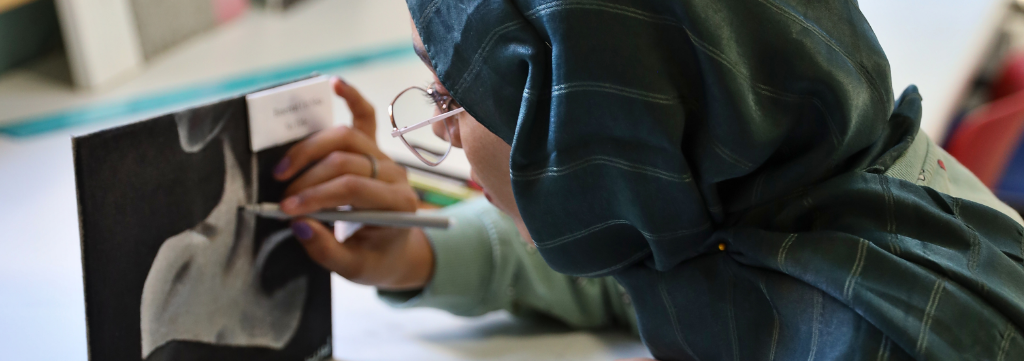
These courses aim to provide students with opportunities to make personal, sociocultural and aesthetic experiences meaningful through the production and understanding of art.
Exemplify and encourage an inquisitive and integrated approach towards visual arts in their various historical and contemporary forms.
At both HL and SL the Visual Arts course consists of two linked compulsory parts:
This course, referred to as The Art of Thinking at UWC Adriatic, is the connective tissue between all the component parts of the IBDP.
The course helps students develop key critical thinking skills and the ability to think across disciplines while exploring knowledge concepts. This course involves meaningful discussion, exploration, interrogation and reflection of the knowledge issues at the heart of our UWC and IBDP experience.
Students learn to draw connections across subjects and experiences with guidance and prompting so that the holistic nature of the UWC and IBDP education models becomes clear.
Each student is required to undertake original research and write an extended essay of 4000 words, with the help of a supervisor who guides the process.
This is an academic research paper which offers the opportunity to investigate a topic of special interest and to become acquainted with the kind of independent research and writing skills expected at university level.
The process of producing the extended essay mirrors that of research at the tertiary level, that involves identifying a research question, submitting a proposal, developing a plan, conducting in-depth research, writing a draft, and finally producing an academic paper.
Please transfer your donation to:
Account holder: FONDAZIONE PER I COLLEGI DEL MONDO UNITO STOCK WEINBERG-EDWARD SUTCLIFFE ENTE FILANTROPICO
Bank: Banca Generali S.P.A, Piazza Unità d’Italia 7, Trieste 34121
IBAN: IT28P0307502200CC8501216016
BIC SWIFT BGENIT2T
Reference: Solidarietà Genitori – Your Full Name
For donations in US Dollars, please transfer your donation to:
Account holder: FONDAZIONE PER I COLLEGI DEL MONDO UNITO STOCK WEINBERG-EDWARD SUTCLIFFE ENTE FILANTROPICO
Bank details: Banca Generali S.P.A, Piazza Unità d’Italia 7, Trieste 34121, Italy
IBAN IT14R 03075 02200 EE8502004530
BIC SWIFT: BGENIT2T
Reference: UWC Adriatic Endowment Fund
For donations in Euro, please transfer your donation to:
Account holder: FONDAZIONE PER I COLLEGI DEL MONDO UNITO STOCK WEINBERG-EDWARD SUTCLIFFE ENTE FILANTROPICO
Bank: Banca Generali S.P.A, Piazza Unità d’Italia 7, Trieste 34121
IBAN:IT59U0307502200CC8500717085
BIC SWIFT BGENIT2T
Reference: UWC Adriatic Endowment Fund
Account holder: COLLEGIO DEL MONDO UNITO DELL’ADRIATICO ETS
Bank: Intesa Sanpaolo S.p.A., Piazza Paolo Ferrari 10, 20121 Milano
A/c number 100000144455
BIC SWIFT BCITITMM
IBAN: IT80Z0306909606100000144455
Reference: Choose a campaign


